
Where Do Our Ideas About ‘Normal’ Come From?
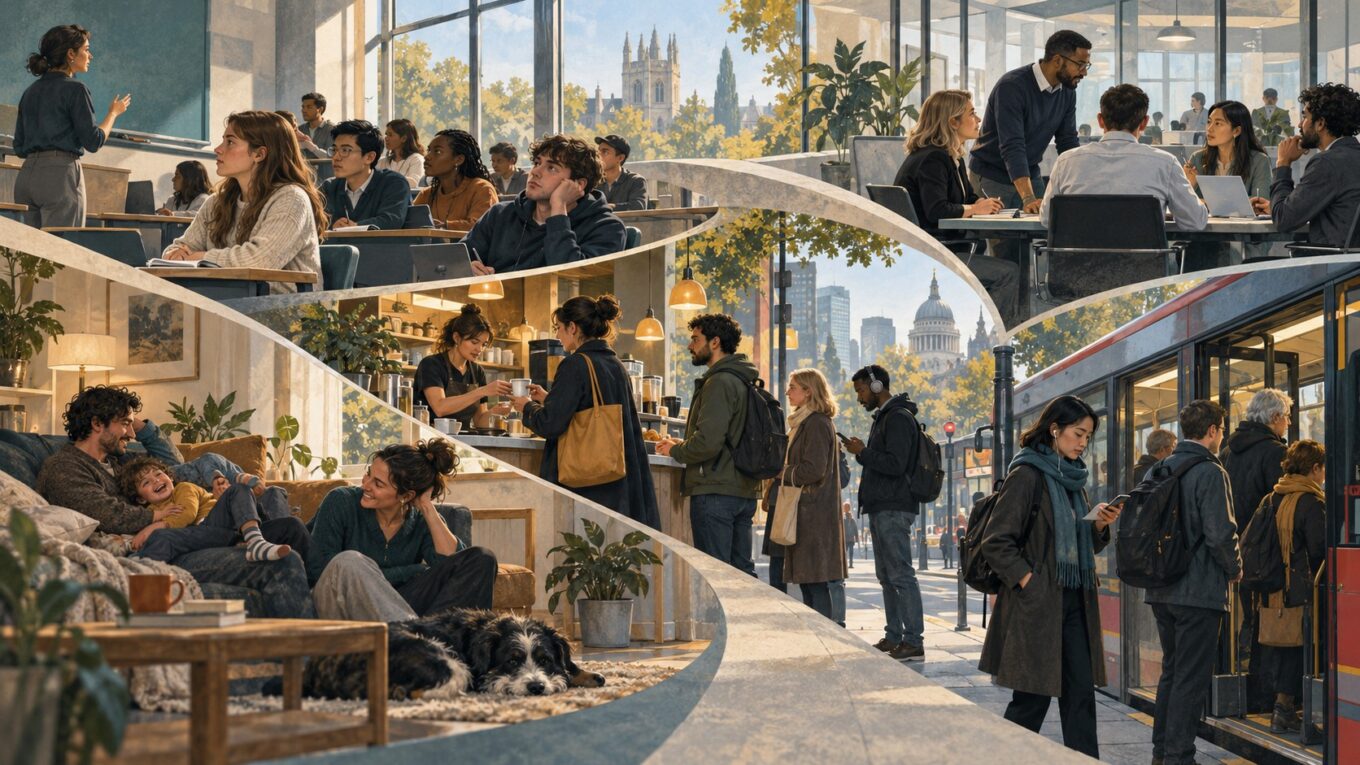
Most of us move through everyday life with a fairly strong sense of what feels normal. We know how loudly to speak in a library, how close to stand to a stranger in a queue, what kind of clothes are suitable for work, and how we are expected to behave at a funeral, wedding or job interview. We also carry ideas about what a normal family looks like, what a normal childhood should involve, how men and women are expected to behave, and what counts as respectable, polite or appropriate.
Much of this feels obvious because we have learned it so thoroughly that we rarely stop to ask where it came from. Sociology asks us to do exactly that.
The first important point is that “normal” is not simply a description of what most people do. It is also a judgement about what people are expected to do. Those expectations are shaped by culture, history, institutions and power, and they can change considerably across different societies and different periods of time.
What feels natural may therefore be much more social than it first appears.
Norms, values and the rules of everyday life
Sociologists use the term norms to describe the informal rules and expectations that guide behaviour. Some norms are obvious, while others are so deeply embedded in everyday life that we barely notice them.
You probably know that it would be unusual to begin eating somebody else’s meal in a restaurant, to answer your phone loudly during a funeral, or to stand facing the back wall in a crowded lift while everyone else faces the door. None of these behaviours is necessarily illegal, but most people would recognise them as breaking social expectations.
Norms help make social life predictable. They allow people to anticipate how others are likely to behave and reduce the amount of negotiation required in everyday interaction. If every social encounter had to begin with people deciding from scratch how to greet one another, how closely to stand, how long to speak or who should take a turn, ordinary life would become exhausting.
Norms are closely connected to values, which are broader ideas about what a society or group regards as important, desirable or worthwhile. A society may value individual freedom, family responsibility, achievement, equality, religious commitment or respect for authority, although these values can conflict with one another and are rarely shared equally by everyone.
Norms are often the practical expression of values. If a society values educational achievement, for example, it may develop norms around school attendance, homework and qualifications. If punctuality is valued, arriving late may be treated as disrespectful or irresponsible.
The important sociological point is that these rules do not simply appear. They are learned, reinforced and sometimes challenged.
How do we learn what is normal?
The process through which people learn the norms, values and expectations of their society is known as socialisation.
Socialisation begins early, but it continues throughout life. Families often play a major role in teaching children how to speak, behave and relate to others, but they are only one influence. Schools, friendship groups, religious organisations, workplaces, television, advertising, online communities and social media all contribute to our understanding of what is expected.
A child may learn at home that interrupting adults is rude, at school that raising a hand is the correct way to speak in class, and among friends that behaving too formally can attract ridicule. Later, workplaces introduce further expectations about dress, communication, hierarchy and professionalism.
These different influences can reinforce one another, but they can also conflict. A young person may encounter one set of expectations at home, another among friends and a third online. Socialisation therefore does not produce identical people. It gives people a range of social expectations that they interpret and negotiate.
This is why sociology does not treat socialisation as simple programming. People can resist norms, reject values and behave differently from what is expected. However, even rebellion usually takes place in relation to existing expectations. You can only break a norm if a norm already exists.
Normal is not the same everywhere
One of the clearest ways to see that normality is socially shaped is to compare different societies.
Practices that feel entirely ordinary in one place can appear unusual somewhere else. Expectations around food, dress, personal space, family responsibilities, religion, marriage and ageing vary widely across cultures.
Even very basic interactions can differ. In some societies direct eye contact may be interpreted as confidence and honesty, while in others it may be seen as disrespectful in certain situations. Ideas about acceptable physical contact, punctuality or hospitality also vary.
This does not mean that every culture is completely separate or that anything can mean anything. Human beings share many needs and capacities, but societies organise and interpret them differently.
The same point becomes even clearer when we look across time.
What seems natural can change
Ideas about normality are not fixed.
Childhood is a good example. Today, in many societies, children are expected to spend much of their time in education and to remain economically dependent on adults for many years. Historically, children were often expected to work at much younger ages and contribute directly to household income.
Marriage has also changed. In many societies it was once primarily an economic, religious or family arrangement, while contemporary Western societies often place much greater emphasis on romantic love and individual choice.
Expectations around gender have changed dramatically too. Jobs that were once considered unsuitable for women are now routine, while many assumptions about fathers, parenting and masculinity have also shifted.
When something changes across time, it becomes difficult to argue that it is simply natural and inevitable. Sociology asks what social processes produced the change.
Social construction
This leads to the idea of social construction.
When sociologists say that something is socially constructed, they are not saying it is imaginary. They are saying that its meaning has been created and maintained through social relationships, institutions and shared understandings.
Money is an easy example. A banknote has little value as a physical object. Its importance comes from the shared belief that it represents value and from the institutions that support that belief.
Other examples are more complex. Ideas about respectable behaviour, gender roles, beauty, intelligence or success all depend partly on social definitions.
Berger and Luckmann (1966) argued that people create social realities through repeated interaction, but those realities can eventually appear objective and independent of the people who created them. In other words, something can begin as a human arrangement and later feel as though it has always existed.
This is one reason norms can feel so powerful.
Who decides what counts as normal?
Not everyone has equal power to define social expectations.
Institutions such as governments, schools, religions, employers and media organisations can play a major role in shaping what counts as acceptable or respectable. Professional groups may define standards of behaviour, while laws can reinforce some norms and challenge others.
Media representations are especially important because they help establish images of what ordinary life is supposed to look like. Repeated portrayals of particular family forms, lifestyles, bodies or identities can influence what people come to see as normal.
This does not mean that people passively absorb whatever institutions tell them. Audiences interpret messages differently, and social norms are often contested. However, some groups have greater ability than others to make their definitions of normality appear authoritative.
That is where normality becomes connected to power.
When normality becomes inequality
Norms can help social life function, but they can also create disadvantages for people who do not fit dominant expectations.
Consider disability. If buildings are designed around the assumption that everyone can walk, climb stairs, hear announcements and read small print, then the environment itself creates barriers for people whose bodies work differently. The problem is not simply an individual impairment. It is also the definition of the “normal” user that has been built into the environment.
Similar issues arise around gender, class, ethnicity and sexuality. A workplace may have informal expectations about how a professional person should speak, dress or behave. Those expectations may appear neutral while favouring people whose backgrounds already fit them.
This is why sociologists are interested not only in what norms are, but in whose experiences they reflect.
Goffman (1963) explored how people can be treated differently when they possess characteristics that others define as socially discrediting. His work on stigma showed how deviations from perceived normality can shape interaction and identity.
The key point is that difference does not automatically create disadvantage. Difference becomes socially significant when societies attach meanings to it.
Deviance and the boundaries of normality
Sociology also uses the concept of deviance to describe behaviour or identities that break social norms.
Deviance does not necessarily mean criminal behaviour. Something can be deviant without being illegal, and something can be illegal without attracting much social disapproval.
This matters because deviance helps reveal where the boundaries of normality lie. When people react strongly to a behaviour, they are often defending a particular understanding of how people should behave.
Durkheim (1895/1982) argued that deviance could actually serve a social function by clarifying moral boundaries. Reactions to rule-breaking remind people what the rules are.
This does not mean all rules are good or that all deviance is harmful. It means that social reactions tell us something about the values a society is trying to protect.
Social media and the speed of normality
The internet and social media have changed how quickly norms can spread.
Ideas about appearance, language, relationships and behaviour can circulate across huge populations almost instantly. Trends that once took years to develop can become widespread in days.
Social media also allows people to see how others behave on an enormous scale. This can strengthen some norms by making them more visible, but it can also expose people to alternatives that challenge local expectations.
At the same time, platforms do not simply show us everything equally. Algorithms influence which behaviours, lifestyles and opinions receive attention. This means that digital platforms can play a role in shaping what appears popular, acceptable or normal.
The process is complicated because users also create the content. People are not simply receiving social norms from above. They are continuously producing, sharing and negotiating them.
This makes social media an especially interesting sociological space because socialisation, power and culture all operate at the same time.
Normal does not mean natural
The sociological lesson is not that norms are meaningless or that society could function without expectations.
Norms are essential to everyday social life. They allow people to cooperate, communicate and understand one another.
The important distinction is between something being normal and something being natural.
A behaviour may feel normal because we have learned it, because everyone around us appears to do it, or because institutions reinforce it. That does not mean it could not have been different.
Once we recognise this, everyday life begins to look less obvious.
Why do we shake hands rather than touch foreheads? Why do some accents sound more authoritative than others? Why is certain clothing treated as professional? Why are particular family arrangements seen as conventional? Why do people feel embarrassed when they break rules that were never written down?
These questions lead directly into sociology because they connect ordinary behaviour with culture, socialisation, power and history.
The next time something feels completely normal, it may therefore be worth asking a simple question:
Normal to whom, and why?
References
- Berger, P. L., & Luckmann, T. (1966). The social construction of reality: A treatise in the sociology of knowledge. Anchor Books.
- Durkheim, E. (1982). The rules of sociological method and selected texts (S. Lukes, Ed.; W. D. Halls, Trans.). Macmillan. (Original work published 1895)
- Goffman, E. (1963). Stigma: Notes on the management of spoiled identity. Prentice-Hall.
Cite this article
Select a style and copy the citation into your document.