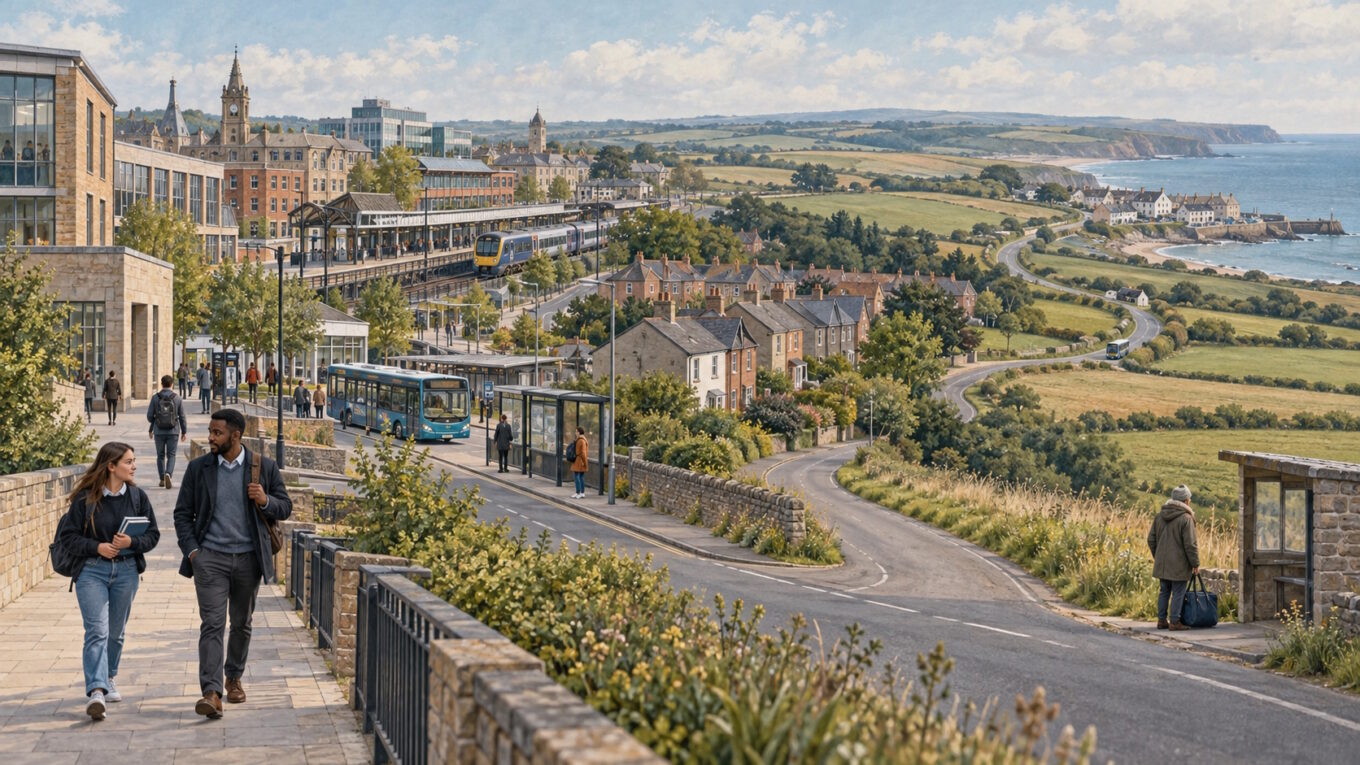
Why Does Where You Live Affect Your Opportunities?
Where we live can feel like a matter of geography, but it is also deeply social. A postcode can influence which schools are nearby, how easy it is to reach work, whether housing is affordable, what healthcare is available, how reliable public transport is, and whether there are safe public spaces, libraries, shops or community services within reach. Two people with similar abilities and ambitions can therefore face very different opportunities simply because they live in different places.
Sociology is interested in this because place is not just the background to social life. It is one of the ways inequality becomes organised and reproduced. Opportunities are distributed through neighbourhoods, towns, cities and regions, and those patterns can become embedded over long periods of time. A former industrial town may still carry the effects of factory closures decades later, while a rural community may appear comfortable from the outside even though residents without cars struggle to reach work, college or healthcare. An expensive urban neighbourhood may offer excellent schools and transport, yet exclude lower-income households through housing costs.
This does not mean that geography determines a person’s future. People move, adapt, travel, build networks and overcome disadvantages. However, where someone lives can shape what is easier, harder, visible or realistically possible. Understanding that relationship helps explain why social inequality is not only about who people are, but also about where they are.
Why place matters
A place is more than a point on a map. It is a combination of institutions, services, relationships, histories and reputations that shape everyday life. Some areas have strong schools, reliable transport, secure employment and easy access to healthcare, while others have fewer jobs, weaker infrastructure or poor housing. These differences are not random. They are usually the result of long-term political, economic and social processes.
Sociologists sometimes use the term spatial inequality to describe the way social advantages and disadvantages become unevenly distributed across places. This matters because people do not encounter society in the abstract. They experience it through particular schools, housing markets, workplaces, transport systems and local services.
Robert Sampson’s work on neighbourhood effects is useful here. He argues that local environments can influence outcomes through institutions, social relationships and collective resources, rather than simply reflecting the characteristics of the people who live there (Sampson, 2012). In other words, where someone lives can become part of the explanation for what happens to them.
This connects closely to the idea of life chances, often associated with Max Weber. Life chances refer to the opportunities people have to achieve things they value, such as education, secure housing, good health or stable employment. Place can shape these chances because opportunities are not evenly available everywhere.
A student living near several colleges with good public transport has a different set of practical choices from someone living in an area where the nearest suitable course is difficult to reach. A worker may have the qualifications for a job but still be unable to take it if commuting is too expensive or unreliable. These differences may look small in isolation, but over time they can accumulate into larger inequalities.
Housing, transport and access to opportunity
Transport provides one of the clearest examples of how geography becomes social inequality. Reliable public transport expands the range of jobs, schools, shops and services that people can realistically reach, while weak transport can shrink those opportunities even when they exist only a few miles away. This matters especially for younger people, older people, disabled people and those on lower incomes, because they may have fewer alternatives to public transport.
A college, hospital or workplace can therefore be geographically close while remaining practically inaccessible. Lucas (2012) argues that transport disadvantage can contribute to social exclusion by restricting access to employment, education, healthcare and social participation, particularly for groups that are already disadvantaged.
The same is increasingly true of digital access. Poor broadband or mobile coverage can affect education, remote work, access to public services and social participation. As more of everyday life moves online, digital connectivity has become another way place can shape opportunity.
Housing creates a second major link between place and inequality because where people live is often determined by what they can afford. In areas with rapidly rising property prices, existing homeowners may gain substantial wealth while renters and younger households face higher barriers to entry. Families with greater resources can often choose neighbourhoods with stronger schools, safer environments and better transport, while lower-income households may have fewer realistic options.
This means housing markets do more than allocate homes. They also help distribute access to opportunity.
The effects can continue across generations. Parents who own valuable property may pass wealth to their children, who can then use it for deposits, education or financial security. In this way, place becomes connected to class reproduction.
Bourdieu’s ideas are helpful here because they show how economic resources interact with cultural and social capital. Living in a well-resourced area can provide access not only to better services but also to networks, expectations and forms of knowledge that help people navigate institutions successfully (Bourdieu, 1986). Place therefore shapes opportunity partly through money, but also through the social environments people encounter.
Reputation, decline and “left behind” places
Places do not only have material conditions. They also have reputations.
Some neighbourhoods, towns or regions become associated with crime, poverty, decline or failure. These labels can influence how residents are treated even when they do not reflect individual circumstances. Sociologists sometimes describe this as territorial stigma, where negative meanings become attached to a place and then to the people who live there.
Wacquant (2007) argues that disadvantaged urban areas can become symbolically marked in ways that deepen exclusion. A place seen as undesirable may receive less investment, while residents may face negative assumptions from employers, institutions or people elsewhere. The reputation of an area can therefore become part of the disadvantage itself.
This process is not limited to urban neighbourhoods. Rural and coastal areas can also acquire labels such as “left behind”, “isolated” or “declining”. These descriptions may capture real inequalities, but they can also flatten complex communities into stereotypes and make decline seem inevitable.
Economic change is one reason some places become associated with decline. When a major employer closes, the consequences rarely stop with job losses. Local businesses may lose customers, younger people may move away, public services may weaken and community institutions may decline. Over time, this can affect housing, education, health, identity and local politics.
The language of deindustrialisation is important here because it reminds us that the decline of a place is often connected to wider economic restructuring rather than individual failure. A town does not become disadvantaged simply because its residents make poor choices. Investment decisions, government policy, infrastructure and global economic change all matter.
This is another example of the sociological imagination. What looks like a local problem may be rooted in processes that operate far beyond the local area.
Why place interacts with other inequalities
Place does not affect everyone in the same way. Its influence depends on how it interacts with class, age, ethnicity, disability, gender and other forms of inequality.
A wealthy household living in a poorly connected area may be able to compensate by owning several cars, paying for private services or moving if necessary. A low-income household in the same area may have no such flexibility. Similarly, an older person, disabled person or young adult may experience the same location very differently because their access to transport, work or services is not the same.
This is why place should not be treated as a simple independent cause. It shapes opportunity through its interaction with other social inequalities.
Two people can live on the same street and still experience that place very differently. One may have secure housing, a car and flexible employment, while another may rent insecurely, rely on public transport and work shifts that make local services difficult to use. Geography matters, but it matters through the social conditions people bring with them.
This also helps explain why rural and urban disadvantage do not look the same. Rural areas may have fewer local jobs, weak public transport and long distances to services, while urban areas may contain high levels of deprivation alongside wealth and opportunity. In both cases, the key issue is not simply location but access.
Does moving solve the problem?
If place affects opportunity, it may seem obvious that people should move somewhere with better prospects. Migration has always been one way individuals and families respond to limited opportunities, but relocation itself requires resources.
Moving may depend on money, housing availability, childcare, employment, transport and social networks. People may also have strong attachments to family, community and place. A higher-paying job elsewhere may be less attractive once housing, commuting and childcare are taken into account, while moving away can mean losing practical support from relatives or friends.
This makes the idea of “just move” much less simple than it sounds.
There is also a wider problem. If the solution to regional inequality is always for individuals to leave disadvantaged areas, then those places may lose the people and skills needed for regeneration. The people most able to move may leave first, while those with fewer resources remain behind in places with declining opportunities.
Sociology therefore asks whether access to opportunity should depend so heavily on mobility in the first place. Should people have to leave their communities to access education, secure work or healthcare, or should those opportunities be distributed more evenly?
That question shifts the focus away from individual adaptation and towards the organisation of society.
Why place matters sociologically
Where we live affects our opportunities because resources, institutions and social networks are not distributed evenly across space. Schools, jobs, transport, healthcare, housing and public services are located somewhere, and access to them depends partly on how society organises places.
This does not mean that geography fixes a person’s future. Individuals make choices, move between places and create opportunities of their own. However, those choices are made within a landscape that already contains unequal resources and constraints.
The sociological question is therefore not simply whether one place is better than another. It is how social advantages and disadvantages become embedded geographically, why some areas accumulate opportunity while others lose it, and how those differences shape people’s life chances.
Once we look at place in this way, a postcode becomes more than an address. It becomes part of the social structure.
That leaves us with a broader question:
If where we live can shape our chances in life, how equal can opportunity really be when places themselves are so unequal?
References
- Bourdieu, P. (1986). The forms of capital. In J. G. Richardson (Ed.), Handbook of theory and research for the sociology of education (pp. 241–258). Greenwood Press.
- Lucas, K. (2012). Transport and social exclusion: Where are we now? Transport Policy, 20, 105–113. https://doi.org/10.1016/j.tranpol.2012.01.013
- Sampson, R. J. (2012). Great American city: Chicago and the enduring neighborhood effect. University of Chicago Press.
- Wacquant, L. (2007). Territorial stigmatization in the age of advanced marginality. Thesis Eleven, 91(1), 66–77. https://doi.org/10.1177/0725513607082003
Cite this article
Select a style and copy the citation into your document.