Andrew Wright

Andrew Wright

Andrew Wright is a higher education (HE) professional and PhD researcher specialising in the sociology of education. His doctoral work examines the reproduction of inequality in post-18 transitions, while his broader interests centre on how structural contexts shape life chances. He is committed to bringing sociological perspectives and research-led insight to public audiences.

Why Do We Believe What We Believe? Sociology, Knowledge, and the Crisis of Truth

Knowledge Is Power - Chernobyl after 40 Years

Forty years after Chernobyl, the reactor sits under a vast steel sarcophagus constructed to contain what could not be unseen. The facts eventually surfaced - but at what cost, and why did it take so long? Drawing on Mannheim, Fricker, Arendt, and Oreskes, this article asks what the sociology of knowledge reveals about the structural conditions under which truth is managed, suppressed, and contested - from Soviet nuclear cover-ups to contemporary populism.

Satisfied? Student Surveys, Social Position, and the Limits of Experience Data

Editorial illustration in muted blue-grey tones of a large ticked survey form, with one confident student at a desk and another uncertain student standing apart, set against a university building.

The National Student Survey ranks institutions, shapes league tables, and features in marketing materials as evidence of teaching excellence. But satisfaction is not the same as learning, and the social position of the student completing the survey shapes what they report in ways the instrument cannot detect. This article applies a Bourdieusian lens to the NSS — and finds that the data is telling us something rather different from what it is used to claim.

Who Gets Accused? AI Detection Bias, Academic Integrity, and the Uneven Field in Higher Education

AI meets academia: a robot faces a gatekeeping professor holding keys.

When universities reach for AI detection tools to police academic integrity, they reach for instruments that are neither accurate nor neutral. Research shows that non-native English speakers, neurodivergent students, and those whose natural writing style resembles AI output face disproportionate false accusations. This article applies a moral panic framework to ask what the response to AI in higher education actually reveals — and who it disadvantages.

The Hidden Curriculum of Soft Skills: Recognition, Capital, and Who Gets Left Out

Young care worker supports an elderly resident, separated by a text-like barrier from an interview panel facing an empty chair.

Job adverts demand communication, leadership, and resilience. But who actually gets credit for them? Drawing on Bourdieu, Puwar, and Rivera, this article argues that soft skills are not recognised neutrally — they are filtered through class, race, and cultural capital. The result is a hiring system that mistakes social advantage for individual merit.

Four Ways of Knowing in Sociology: Positivism, Interpretivism, Critical Realism and Pragmatism

Illustration divided into four panels around a central compass and globe, showing four ways of seeing the social world: quantitative measurement, shared meaning and ideas, hidden structures beneath the surface, and practical tools for building solutions.

Sociology is not just about what we study, but how we think we can know anything about the social world. This explainer introduces four major epistemological approaches – positivism, interpretivism, critical realism and pragmatism – and shows how each one answers basic questions about reality, knowledge and methods. Aimed at undergraduate sociology students, it offers a clear map of the terrain and helps you understand why different writers disagree about what counts as good evidence or explanation.

From Access to Belonging: Rethinking Widening Participation Metrics in UK Higher Education

Students on campus sit and talk while, beside them, a large dashboard of widening participation data highlights targets and inequalities.

Widening participation policy is often judged through dashboards of access, continuation and attainment. Yet focusing on who gets in – and who stays – can mask how universities continue to privilege particular histories, dispositions and futures. Drawing on Bourdieu’s concepts of habitus, capital and institutional habitus, this article argues that belonging should sit at the centre of how we interpret student data, and explores what a more “belonging-sensitive” approach to WP metrics might look like in UK higher education.

Are Your Student Recruitment Dashboards Misleading You? Funnels, Conversion, and Inequality in HE

University data dashboard flowing into a funnel with colourful people icons dropping out at different points.

Student recruitment dashboards promise a single version of the truth about who will enrol. This article shows how small choices about funnels, conversion and melt can create competing “truths”, quietly shape who gets attention, and reproduce inequality in HE – and suggests practical ways to use dashboards, AI and KPIs more reflexively.

The Debt Trap and the Class Gap: Why Student Loan Warnings Are a Form of Gatekeeping

The Student Debt Trap

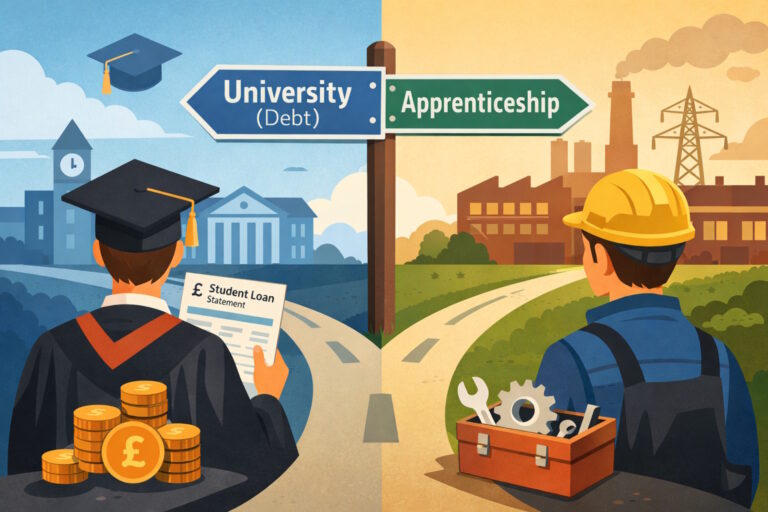
This article uses Johanna Noble’s recent column on Plan 2 student loans to ask who is really put off university by talk of a “graduate tax”. Drawing on research on first-in-family and working-class students, it shows how fear of debt, school guidance, and weak vocational routes combine to reproduce classed access to higher education.

“I Heard It on the Grapevine”: How Parent and Student Networks Quietly Shape School and University Choices

Hot Knowledge

League tables and Ofsted reports matter, but school and university choices are often decided on the grapevine. This piece shows how parent networks, WhatsApp chats and “hot” knowledge quietly reproduce advantage—and why first-in-family and working-class students are left with thinner information.