I was watching Trading Places the other evening, doing what I assumed was fairly standard seasonal downtime: Christmas film, familiar jokes, low-stakes nostalgia. The film is, after all, marketed as light festive comedy—snow, parties, Santa outfits, and a final scene on a tropical beach funded by a well-timed coup in the commodities market.
Even so, I found it difficult to watch without a sociological itch kicking in, and not for the first time. The more often I re-encounter popular culture while immersed in studying and writing about inequality, the harder it becomes not to see theories everywhere. Trading Places in particular keeps inviting that question: what exactly is being “tested” in this story, and what are we supposed to conclude when the credits roll?
In the film, two ageing Wall Street brothers—Randolph and Mortimer Duke—conduct what they refer to as a scientific experiment. They decide to switch the lives of Louis Winthorpe III, their privileged white commodities broker, and Billy Ray Valentine, a Black street hustler they encounter by chance. Their wager is simple: if they swap the men’s positions, will Louis’s “good breeding” prevail even in poverty, or will Billy Ray’s “nature” betray him even when he is given money, a job, and status?
On the surface, this is framed as a nature versus nurture question, and the film seems to offer a satisfying answer. Billy Ray quickly proves himself a talented trader once given the opportunity, while Louis spirals into disgrace. The message appears to be that environment matters more than innate qualities, and that a talented outsider can flourish when finally given a chance. As seasonal moral lessons go, this sounds appealing: generosity, second chances, and the victory of underdogs over snobbish elites.
Looked at sociologically, however, the wager is not really about nature or nurture at all. What Trading Places accidentally stages is a thought experiment in capital, class, and recognition. The film turns on a more structural question: how life chances shift when access to economic resources, cultural know-how, social networks, and symbolic status is abruptly rearranged—but the rules of the wider game remain intact? To answer that question, we need a different vocabulary from “breeding” and “environment”.
Pierre Bourdieu’s framework offers just such a vocabulary. By thinking in terms of capital and social fields rather than isolated individuals, we can see Trading Places not as evidence that meritocracy works, but as a narrative that both depends on and obscures unequal distributions of power.
From Nature vs Nurture to Capital and Structure
Why “nature vs nurture” is the wrong frame
The Duke brothers’ wager draws on a familiar binary. On one side sits “nature”: inherited traits, character, and supposed biological differences. On the other is “nurture”: upbringing, environment, and socialisation. This binary comes largely from psychology and biology, where debates focus on how much of a person’s behaviour is shaped by genetics versus early experiences.
Sociology starts from a different place. It does not deny that people vary in temperament or ability. Instead, it asks how those differences are filtered through social structures: who gets their talents recognised, rewarded, and developed, and who finds that the same skills are ignored, mocked, or criminalised? Who gets their talents recognised, rewarded, and developed? Who finds that the same skills are ignored, mocked, or criminalised? Once we shift the focus from individuals to structures, the story of Trading Places looks less like a test of human nature and more like a test of unequal access to resources.
This is where meritocracy enters the picture. Meritocracy is the belief that rewards—jobs, income, status—reflect individual talent and effort rather than inherited advantage. In a genuinely meritocratic society, a Christmas film about a street hustler becoming a successful commodities trader would illustrate how open opportunities are. If everyone faces the same conditions, then exceptional performance can be taken as evidence of merit (Young, 1958; Littler, 2017).
Yet meritocracy easily slides into ideology: an attractive story that disguises how advantage actually works. When social systems are already deeply unequal, a handful of spectacular success stories can be used to defend the status quo. If one Billy Ray can make it, the argument goes, then anyone could—so those who remain poor must lack either talent or effort. It is precisely this slippage that Trading Places allows us to explore.
Bourdieu’s framework: field, habitus, and capital
Pierre Bourdieu offers a way to think about inequality that goes beyond nature versus nurture and beyond individual success stories. His theory of practice centres on three interconnected ideas: field, habitus, and capital (Bourdieu, 1986).
A field is a relatively autonomous social arena with its own rules, hierarchies, and valued resources. Finance, education, law, and art are all examples. In Trading Places, the key field is the world of commodities trading: a space where particular forms of knowledge, style, and connection are rewarded.
Habitus refers to the deeply ingrained dispositions, habits, and expectations that people acquire through their upbringing and experiences. It shapes what feels natural, which futures seem plausible, and how comfortable we feel in different settings. Louis and Billy Ray enter the film with very different habitus, formed in sharply contrasting social worlds.
Capital, finally, refers to the resources that individuals and groups can draw on within a field. Bourdieu distinguishes several key forms:
- Economic capital – money, property, and other financial assets.
- Cultural capital – knowledge, tastes, skills, and manners that are valued in a given field, including formal qualifications.
- Social capital – networks of relationships that provide support, information, or opportunities.
- Symbolic capital – prestige and legitimacy: the recognition that makes other forms of capital count as valid.
Crucially, these forms of capital can be converted into one another. Economic capital can buy elite education. Cultural capital can lead to better jobs. Social capital can become symbolic capital when time spent with the “right” people signals status (Bourdieu, 1986). What matters is not only how much capital individuals hold, but whether their capital is recognised as legitimate in a particular field.
Meritocracy as misrecognition
Bourdieu’s notion of misrecognition is central here. Misrecognition occurs when social advantages are perceived as natural, deserved, or simply the outcome of effort. Elite accents, confident body language, and prestigious schools are taken as signs of individual quality. Their roots in privilege disappear from view. The underlying distribution of capital is obscured (Bourdieu, 1990).
Seen from this angle, the Dukes misrecognise Louis’s prior success as evidence of superior nature and Billy Ray’s marginality as evidence of inherent inferiority. Their “experiment” does not start from a neutral baseline. It begins with two people who have been differently positioned for years by classed and racialised distributions of capital. What the film allows us to see—if we watch with Bourdieu in mind—is how quickly fortunes change when the flow of capital and recognition is redirected.
What Louis and Billy Ray Start With: Mapping Capital at the Beginning
Before the lives of Louis and Billy Ray are swapped, the film carefully establishes who they are and how they are treated. These opening scenes are often played for humour, but they provide a snapshot of two very different bundles of capital and recognition.
Louis: dense capital and unquestioned legitimacy
Louis Winthorpe III is introduced as the embodiment of upper-class respectability. He works as a commodities broker for the Dukes, lives in a large townhouse, and is engaged to a woman from a similarly privileged background. Every aspect of his life signals economic and cultural wealth.
In terms of economic capital, Louis enjoys a high income, inherited security, and access to exclusive financial instruments. His wealth is not only personal; it is embedded in a broader network of investments and institutional backing.
His cultural capital is equally dense. Embodied in his accent, wardrobe, and mannerisms, it marks him as someone who belongs in elite spaces. We can infer a history of prestigious schooling and socialisation into the rituals of clubs and country houses. This capital is also institutionalised in his professional status: he is not simply employed, but trusted with complex financial decisions.
Louis’s social capital is extensive. He has close ties to the Dukes, to colleagues on the trading floor, and to members of his social circle. These are not just friendships; they are networks of mutual recognition that open doors and protect reputations.
All of this accumulates as symbolic capital. Guards, servants, and strangers treat Louis as respectable and intelligent before he does anything to justify their trust. In an early scene at the Dukes’ offices, for example, a uniformed guard simply waves him through with a greeting. His presence in certain spaces—a members’ club, a business meeting—appears natural. Legitimacy precedes action.
Billy Ray: constrained capital and racialised suspicion
Billy Ray Valentine, by contrast, is introduced in a street scene that foregrounds precarity and criminalisation. He is improvising a scam for small change, using a false disability to extract sympathy from passers-by. Police officers and pedestrians respond with suspicion and irritation; he is moved on, shouted at, and eventually arrested after a chance collision with Louis.
In terms of economic capital, Billy Ray has almost none. He appears to be living hand-to-mouth, with no savings or secure income. His primary resource is his ability to hustle in an unforgiving urban environment.
Yet Billy Ray clearly possesses forms of cultural capital—just not those recognised within the financial field. He is quick-witted, verbally agile, and skilled at reading people. These are genuine competences, but in the eyes of the Dukes and the police they register as deviance rather than intelligence.
Billy Ray’s social capital is limited and localised. He likely has ties within street economies and neighbourhood networks, but these connections do not translate into formal opportunities. They may provide emotional support or short-term survival strategies, yet they carry little weight when it comes to jobs, housing, or legal protection.
Most dramatically, Billy Ray is marked by an absence of symbolic capital. As a Black man associated with minor crime, he is read through a lens of racialised suspicion. Security staff and police treat him as dangerous or dishonest before he acts. When he collides with Louis outside the Dukes’ offices, a guard immediately grabs him and the police are called. His presence in certain spaces—Louis’s club, the Dukes’ offices—is perceived as an intrusion, requiring explanation or removal.
Comparing starting positions
If we map these differences, the contrast is stark. One character begins the story surrounded by economic security, cultural ease, dense networks, and automatic legitimacy. The other starts with precarious income, devalued skills, fragile networks, and a constant presumption of guilt. This is not a neutral starting point for an “experiment” about human nature. It is a snapshot of an unequal social order in which race and class are tightly entangled (Du Bois, 1903).
Table 1 summarises these starting positions in terms of Bourdieu’s key forms of capital.
Table 1. Louis and Billy Ray’s starting capital in the Wall Street field
| Character | Economic capital | Cultural capital | Social capital | Symbolic capital |
|---|---|---|---|---|
| Louis Winthorpe III | High income; inherited security; access to elite financial assets | Elite accent and manners; familiarity with upper-class codes; professional expertise | Dense networks with the Dukes, colleagues, and club members | Taken-for-granted legitimacy; routinely treated as competent, honest, and deserving of trust |
| Billy Ray Valentine | Irregular, low income; no savings; immediate survival pressures | Verbal agility, improvisation, and street skills that are not recognised as valuable in finance | Localised neighbourhood ties with little traction in formal institutions | Racialised suspicion; routinely treated as dishonest or dangerous; presence in elite spaces seen as out of place |
Seen in this way, the wager begins to look less like a genuine test of nature versus nurture and more like a demonstration of how the flow of capital shapes people’s lives when it is suddenly reversed.
Swapping Positions: What Changes and What Stays the Same?
Once the Dukes set their plan in motion, the narrative follows two intertwined arcs: Billy Ray’s rapid ascent into the world of commodities trading and Louis’s equally rapid descent into poverty and criminalisation. Both arcs can be read as processes of capital conversion and withdrawal.
Billy Ray’s rise with institutional backing
When Billy Ray is brought into the Dukes’ firm, he is not simply handed money. He is installed into an institutional ecosystem that activates and amplifies his abilities. He is given a salary, a house, staff, and the outward trappings of status. More importantly, he receives instruction and mentorship. Colleagues explain the mechanics of the trading floor, translate jargon, and model appropriate conduct.
This is a textbook example of capital conversion. Access to economic capital—a stable income and credit—removes immediate survival pressures, allowing Billy Ray to focus on learning. The Dukes’ endorsement furnishes him with symbolic capital: he is introduced as an executive, and others are expected to treat him accordingly. This symbolic recognition, in turn, secures social capital in the form of collegial relationships and client trust.
Within this protected environment, Billy Ray’s existing talents—his ease with numbers, his ability to read people, his improvisational skills—are quickly reclassified. What looked like hustling on the street becomes valuable cultural capital. The film compresses this process for comic effect, but the underlying logic is sociologically recognisable. Once his abilities are recognised and nurtured within a supportive field, he performs well.
At no point does the narrative suggest that Billy Ray’s “nature” has changed. What changes is his position in the field and the resources that position unlocks. Institutional backing turns a marginalised hustler into a successful trader in a matter of weeks. The implication is clear: many people possess talents that remain dormant or misrecognised because they lack access to the right combinations of capital.
Louis’s fall when capital and recognition are withdrawn
Louis’s storyline follows the opposite trajectory. Stripped of his job, framed for theft, and abandoned by his fiancée, he moves rapidly from status to stigma. His accounts are frozen; his belongings are removed; his club membership is revoked. In a series of increasingly chaotic scenes, he loses not only his home but also his sense of self.
Here again, the logic is one of capital withdrawal. Once his economic capital is cut off, Louis has no immediate means of support. Without the backing of the Dukes, his symbolic capital collapses. Security staff who once deferred to him now treat him as a threat. Former friends distance themselves to avoid contamination by scandal.
As his social capital evaporates, Louis is left with few supportive ties. His attempts to draw on past connections fail because the field no longer recognises him as legitimate. Even his cultural capital—his accent, manners, and education—offers little protection. In the context of homelessness and unemployment, those traits simply mark him as a fallen gentleman rather than restoring his status.
The speed of this collapse is exaggerated for narrative effect, but the pattern is familiar. Once institutions label someone deviant, their actions and capacities are reinterpreted through that label. Behaviours that previously signalled competence are now read as delusion or desperation. The same person is seen differently because their position in the field has changed.
Race, class, and conditional inclusion
The swap also highlights how race and class interact to shape the terms of inclusion. Billy Ray’s success in the firm does not erase the racialised stereotypes that surround him. Jokes and asides remind the audience that his presence in elite spaces remains surprising to some characters. His inclusion is conditional: he is celebrated while he performs profitably and conforms to expectations.
Louis, meanwhile, experiences a brief encounter with the kind of suspicion routinely directed at Billy Ray. Once he is poor, dishevelled, and desperate, he is treated as a threat in spaces that once welcomed him. The film uses these reversals for comedy, but they echo a serious sociological point. Respectability is not a stable personal trait; it is a status granted or withdrawn by institutions and observers (Skeggs, 1997).
We might represent these dynamics with a simple diagram:
Figure 2. Capital conversion and withdrawal in Trading Places
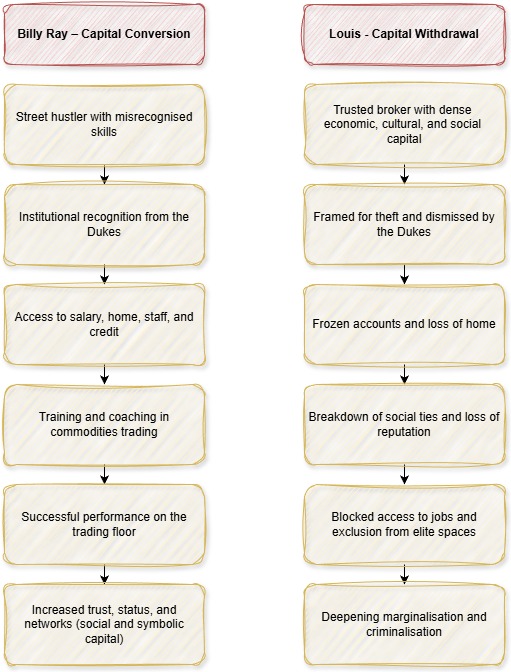
Taken together, these trajectories challenge a straightforward meritocratic reading. Both men’s fates are tightly linked to flows of capital and recognition over which they initially have little control.
The Comfort of the Happy Ending: How Meritocracy Is Reasserted
If much of Trading Places invites a critical reading of class and race, its ending steers the audience back towards a more comforting message. Once Louis and Billy Ray discover the Dukes’ deception, they join forces to turn the tables. Using inside knowledge of an upcoming crop report, they outmanoeuvre the brothers on the trading floor, causing the Dukes’ financial ruin and securing a fortune for themselves.
Winning by playing the game better
On one level, this is satisfying. The two men most harmed by the wager collaborate to defeat their exploiters using the very tools of the financial field. Their victory appears to signal that intelligence, courage, and solidarity can overcome entrenched power. In Christmas-movie terms, justice is done.
From a sociological perspective, though, the nature of this justice is telling. The outcome does not involve challenging the rules of the game. There is no suggestion that commodities speculation itself is unjust, that racialised policing of poverty should be dismantled, or that the structures enabling the Dukes’ power need reform. Instead, the plot rewards Louis and Billy Ray for mastering the existing system more effectively than their former employers.
In Bourdieu’s terms, they become dominant players within the same field. They accumulate vast economic capital, consolidate it through social and symbolic recognition, and withdraw from the world of everyday scarcity. The closing scenes show them enjoying leisure on a private beach—still inside the universe of luxury that the film has taken for granted throughout.
Exceptionalism as legitimation
This ending exemplifies a broader pattern in meritocratic narratives. Exceptional individuals from disadvantaged backgrounds are celebrated as proof that the system ultimately works. Their success stories are retold in media, politics, and education as evidence that opportunities are open. If some make it from the street to the boardroom, then the barriers cannot be too high.
Sociologists of meritocracy stress that these exceptional cases often perform ideological work (Young, 1958; Littler, 2017). They encourage audiences to focus on individual grit and ingenuity rather than on distributions of capital. The structural processes that kept most people in Billy Ray’s original position are left unexplored.
Trading Places follows this pattern. We are invited to feel pleased that one marginalised man has been recognised and elevated. Yet the film says almost nothing about Billy Ray’s former neighbours, or about others who will never receive a philanthropic wager from bored millionaires. The lives of the broader Black working class, whose experiences Du Bois called the “problem of the colour line”, remain off-screen (Du Bois, 1903).
The absent majority
Thinking sociologically requires us to bring this absent majority back into view. A genuine assessment of equality of opportunity would not hinge on a single Christmas miracle, but on patterns: who tends to rise, who tends to fall, and under what conditions. It would ask how many Billy Rays never meet a Duke, or are criminalised rather than mentored when they cross paths with wealth.
In this sense, the film’s upbeat resolution risks reinforcing the very meritocratic illusion it has spent much of its runtime quietly undermining. It allows viewers to enjoy a fantasy of just deserts without confronting how rarely such reversals occur outside fiction.
Beyond the Film: What Would a Sociological “Experiment” Look Like?
The Dukes describe their wager as an experiment, but from a sociological standpoint it fails almost every test of methodological adequacy. It has only two cases, no ethical safeguards, and a complete disregard for consent. Yet the fantasy of a clean life swap remains attractive, not least because it promises to reveal “true” character.
A sociological approach would look very different. Rather than swapping two individuals and watching what happens, researchers would examine patterns across many lives. Studies of class mobility, for instance, track how often people move between occupational classes over generations and how this varies by race, gender, and location. Rather than focusing on one spectacular story, they ask what proportion of people from backgrounds like Billy Ray’s achieve outcomes like Louis’s—and what obstacles stand in their way.
Similarly, research on labour market discrimination uses methods such as audit studies, where matched job applications differing only in names or postcodes are sent to employers. Differences in callback rates indicate how racial or class markers operate in practice. These approaches treat inequality as a structural phenomenon to be measured and explained, not as a moral drama between a handful of individuals.
A postscript from the trading floor
The orange juice scam at the climax of Trading Places turned out to be more than just a plot device. After the 2008 financial crisis, US lawmakers moved to close a loophole that had made it unclear whether using confidential government crop reports to trade commodities was illegal. As part of the Dodd–Frank financial reforms in 2010, the Commodity Futures Trading Commission introduced a provision—colloquially dubbed the “Eddie Murphy rule” or “Trading Places law”—that explicitly bans trading in commodity markets on the basis of misappropriated government information. In other words, the Dukes’ fictional scheme now has a small but real regulatory afterlife.
Trading Places can still play a role in sociological thinking. Its caricatured elites, racial jokes, and compressed narrative timelines offer a stylised portrait of inequalities that sociologists document in far more mundane forms. The film hints that talent is widely distributed whereas recognition is not; it shows how quickly institutions can withdraw support; and it invites viewers to wonder how many other lives might change if access to capital and status were redistributed.
Yet the film also hides much. It glosses over the histories of racial capitalism that shaped the Dukes’ fortune, the colonial and imperial legacies underpinning global commodity markets, and the collective struggles that have challenged such systems. It replaces these complex stories with a neat arc of betrayal and revenge, resolved in time for Christmas.
Why Trading Places Is Still Fun to Watch – and Worth Thinking About
A Christmas comedy about frozen orange juice futures may not seem like an obvious starting point for theorising inequality. It is also, quite simply, a very good film: sharply written, brilliantly performed, and still genuinely funny decades after its release. At the same time, Trading Places illustrates how popular culture can both expose and soften the realities of class and race. What the film stages as a test of nature versus nurture is better understood as a rapid reconfiguration of capital within a stable field.
When Billy Ray prospers with institutional backing and Louis flounders without it, we are not witnessing the triumph of good character over bad breeding. We are seeing how economic security, cultural coaching, social networks, and symbolic legitimacy make certain forms of success possible and others unlikely. Bourdieu’s concepts of capital and field help translate a festive narrative into a sharper analysis of how inequality is reproduced—and occasionally disrupted—without ever being fundamentally transformed.
For viewers who, like many sociologists, find it hard to switch off analytic habits even during seasonal film marathons, Trading Places offers a useful reminder. Enjoyment and analysis do not have to be in tension. You can laugh at the jokes, appreciate the performances, and still notice what the story is doing with class, race, and meritocracy. Changing who occupies elite positions is not the same as changing the structures that create elites in the first place. The real question is not whether one or two outsiders can be welcomed into the beach house, but how the rules of the game might be rewritten so that life chances are not so tightly bound to where—and to whom—you happen to be born.
References
- Bourdieu, P. (1984). Distinction: A social critique of the judgement of taste. London, UK: Routledge.
- Bourdieu, P. (1986). The forms of capital. In J. G. Richardson (Ed.), Handbook of theory and research for the sociology of education (pp. 241–258). New York, NY: Greenwood.
- Bourdieu, P. (1990). The logic of practice. Cambridge, UK: Polity.
- Du Bois, W. E. B. (1903). The souls of Black folk. Chicago, IL: A. C. McClurg.
- Littler, J. (2017). Against meritocracy: Culture, power and myths of mobility. London, UK: Routledge.
- Skeggs, B. (1997). Formations of class and gender: Becoming respectable. London, UK: Sage.
- Young, M. (1958). The rise of the meritocracy, 1870–2033: An essay on education and equality. London, UK: Thames & Hudson.
Cite this article
Select a style and copy the citation into your document.