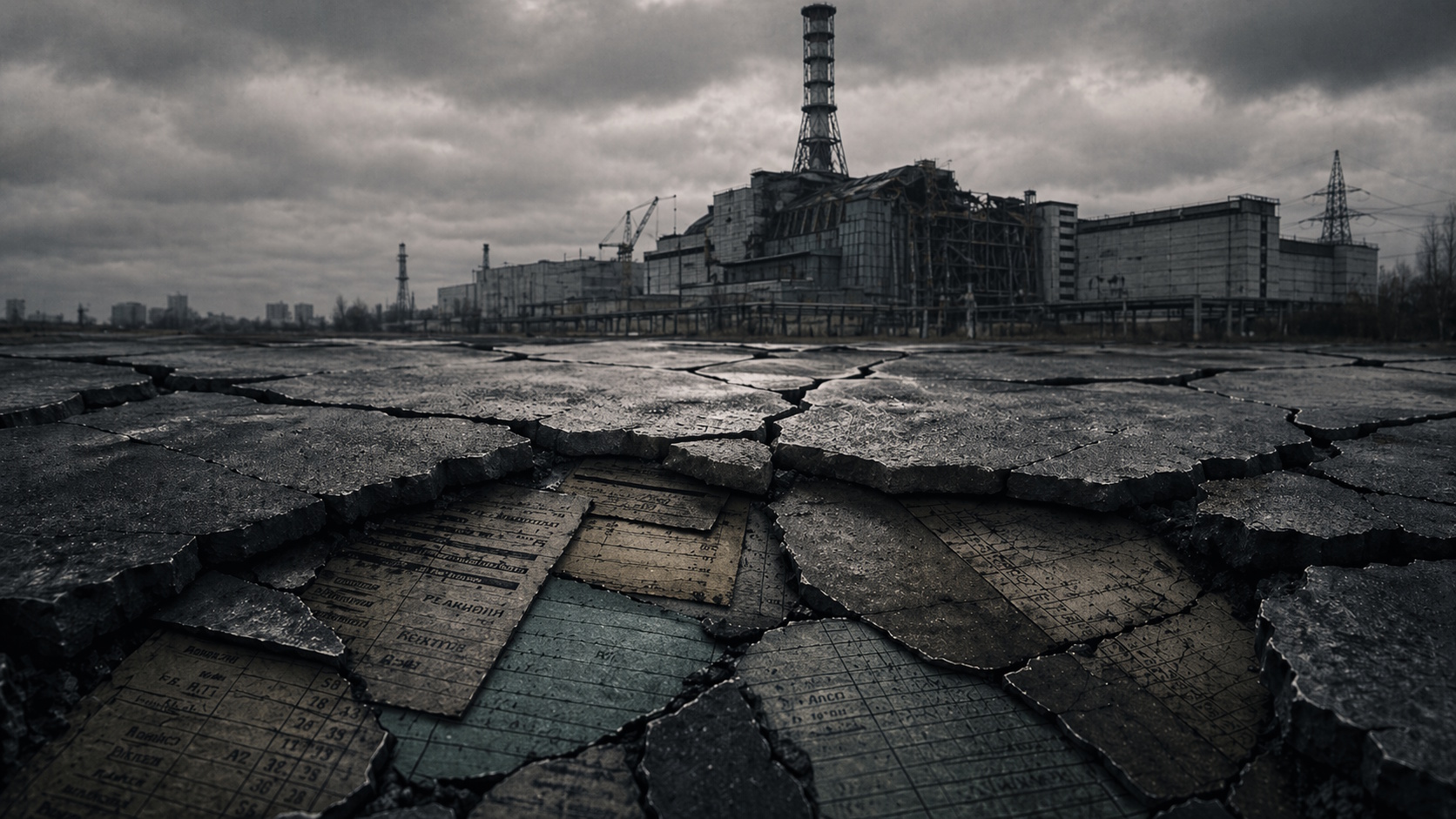
On the 26th of April 1986, reactor number four at the Chernobyl Nuclear Power Plant exploded. Within hours, Soviet officials knew they were facing a catastrophe of historic proportions. What followed was not a transparent response to a technical disaster. It was a carefully managed campaign to control what could be known, who was permitted to say it, and who would ultimately bear responsibility. This Sunday marks the fortieth anniversary of that explosion. The disaster killed people directly and, through radiation exposure, many more — estimates of the long-term death toll remain contested, but no serious account places it as trivial. It also offers sociology one of its most instructive case studies in how knowledge is managed, suppressed, and ultimately contested.
Chernobyl is not simply a story about a nuclear accident. It is a story about the social conditions under which truth is produced, protected, and dismantled — conditions that are not unique to Soviet-era totalitarianism. They are visible today in the Kremlin’s conduct of its invasion of Ukraine, and in the epistemic politics of a political culture that treats expertise as an instrument of elite conspiracy. The question this article asks is a sociological one: what are the structural conditions under which knowledge is treated as credible, suppressed, or weaponised? And what does sociology offer us in understanding why that question matters so urgently now?
What the sociology of knowledge actually claims
The sociology of knowledge begins with a deceptively simple observation: all knowledge is produced by people who are located somewhere. Every claim about the world is made from a particular social position, within particular institutional arrangements, shaped by particular interests and assumptions. Knowledge does not descend from outside society. It is made inside it.
This insight is most associated with Karl Mannheim, whose work in the early twentieth century laid the foundations for a systematic sociological approach to knowledge production. Mannheim argued that ideas are not free-floating — they are socially situated, and understanding them requires understanding the social conditions from which they emerge (Mannheim, 1936). A conservative and a socialist looking at the same set of economic facts are not simply reaching different conclusions. They are seeing the world through frameworks shaped by their class position, their historical moment, and the interests those positions produce.
The claim can sound unsettling at first, and for understandable reasons. It sounds like relativism — if all knowledge is socially shaped, does that mean all claims are equally valid? Does it mean that science is just another perspective? Mannheim was careful to resist this reading. His concept of relationism is distinct from relativism: the point is not that truth is impossible, but that the conditions under which knowledge is produced always require examination. The sociologist’s task is not to dismiss knowledge claims but to ask who is producing them, from where, under what institutional pressures, and with what consequences.
Peter Berger and Thomas Luckmann extended this framework beyond ideology into the texture of ordinary life. What people treat as common sense — the taken-for-granted world of routine knowledge — is itself a social construction, produced through interaction and sustained through institutional practice (Berger & Luckmann, 1966). The sociology of knowledge concerns the mundane processes through which any society decides what counts as real, what counts as obvious, and what is too dangerous or absurd to take seriously. That mundane dimension is where much of the real action lies — and it applies not only to authoritarian states but to all social orders, including liberal ones.
Chernobyl: when the state cannot know what it knows
At approximately 1:23 in the morning on 26th April 1986, the RBMK-1000 reactor at Chernobyl underwent a sudden and catastrophic power surge during a safety test. The reactor’s design had a fundamental flaw: under certain conditions, a drop in power could cause a dangerous increase in reactivity rather than a reduction. Soviet engineers had known about this characteristic. The information had circulated within certain technical communities, but had not been widely shared, and the operators conducting the test that night were not adequately informed of the risk (Plokhy, 2018).
The suppression of technically critical knowledge was not an accident. The Soviet system created institutional pressures that made acknowledging design flaws extremely dangerous for those who identified them. To raise a concern about the RBMK reactor’s design was to question the competence of the system that had produced it. In a political culture organised around the infallibility of central planning, that was not a safe position to occupy.
When the explosion occurred, the response followed a familiar pattern. Local officials reported the situation as contained. Plant director Viktor Bryukhanov sent a report to Moscow significantly underestimating radiation levels, partly because the dosimeters capable of measuring the actual levels had been locked away (Higginbotham, 2019). Whether this reflected deliberate concealment, institutional self-protection, or a bureaucratic incapacity to process an outcome the system had declared impossible is something historians continue to debate. What is clear is that the institutional machinery produced a distorted account of events, and that distortion shaped the initial response in ways that worsened the disaster’s human cost.
The Swedish intervention changed things. On the morning of 28th April 1986, workers arriving at Forsmark Nuclear Power Plant were found to be contaminated. The radiation was not from Forsmark. Systematic monitoring established that the source was to the east. Sweden raised the alarm internationally, and the Soviet Union, confronted with independent evidence it could not contain, acknowledged that an accident had occurred (Josephson, 2000).
This moment matters for the sociology of knowledge. The Swedish detection was possible because Sweden operated within a different institutional framework: independent monitoring systems, no ideological investment in suppressing the finding, no structural pressure on scientists to produce a particular result. The same physical reality generated different epistemic outcomes depending on the institutional conditions in which knowledge was being produced. Mannheim’s point could hardly be illustrated more vividly.
What followed the initial disclosure continued the pattern. The Soviet state’s official account attributed the disaster overwhelmingly to operator error. The night shift workers, and in particular deputy chief engineer Anatoly Dyatlov, were prosecuted and imprisoned. Framing individual blame served a clear ideological function: it preserved the integrity of the Soviet nuclear programme and deflected attention from the RBMK reactor’s design characteristics, which were a product of the system itself. The International Nuclear Safety Advisory Group’s post-accident assessment eventually identified design flaws as a primary causal factor, and subsequent analysis has continued to complicate the operator-error narrative (INSAG, 1992).
The workers who knew something was catastrophically wrong could not, in most cases, make that knowledge count. They lacked institutional credibility. Their testimony was filtered through a system that had already determined its preferred account. This is what the philosopher Miranda Fricker calls testimonial injustice.
Who gets to count as a knower?
Fricker’s concept of epistemic injustice refers to the wrong done to someone specifically in their capacity as a knower. She identifies two principal forms. Testimonial injustice occurs when a speaker is assigned less credibility than their evidence warrants, on the basis of a prejudice the listener holds about the social group to which the speaker belongs (Fricker, 2007). Hermeneutical injustice occurs when a gap in collective interpretive resources puts someone at an unfair disadvantage when making sense of their own experience.
The Chernobyl case illustrates both. Operators and low-ranking workers who understood what was happening in the reactor building had their accounts systematically discounted — their credibility as knowers compromised not by any failure of actual knowledge, but by their position within a hierarchy that had strong structural reasons to disbelieve them. The testimony that mattered was the testimony that suited the system.
Hermeneutical injustice is subtler. It arises when the concepts required to name and articulate an experience do not exist in the available cultural vocabulary, because the group most affected has been excluded from the processes that produce that vocabulary. Fricker’s own central example involves sexual harassment before that term existed as a recognised category: women experienced something real and harmful, but lacked the conceptual tool to name it precisely, which made it harder to articulate, resist, and seek redress for (Fricker, 2007). At Chernobyl, hermeneutical injustice operated through the absence of an institutional vocabulary for systemic failure. The Soviet technical and political culture had not developed conceptual resources for articulating design failure without that articulation becoming simultaneously a political accusation. The language available was the language of human error, individual negligence, and sabotage. There was no neutral space in which to say: the reactor was dangerous by design.
José Medina extends Fricker’s framework, arguing that epistemic injustice is reproduced not only through individual prejudice but through the accumulated practices of groups and institutions, embedding what he calls epistemic vices — closed-mindedness, arrogance, and intellectual laziness — into the architecture of how organisations process claims (Medina, 2013). Gender, race, class, and institutional position all shape whose knowledge is treated as worthy of serious engagement, and these patterns persist without requiring any individual actor to be consciously discriminatory. The discrimination is structural, which is precisely why it is so difficult to dislodge.
Science, institutions, and the production of credible knowledge
If knowledge is socially shaped, what distinguishes reliable knowledge from self-serving narrative? This is a genuine question, and it deserves a serious answer.
Robert Merton argued that science operated according to a distinctive set of institutional norms: communalism, universalism, disinterestedness, and organised scepticism (Merton, 1973). Taken together, these describe an institutional structure designed to minimise the distorting effects of individual interest and social position — one in which no claim is exempt from challenge on the basis of the authority of its author. Merton’s account was normative as much as descriptive; it captured an ideal rather than a constant practice. Shapin and Schaffer’s meticulous historical study of seventeenth-century debates about experimental method showed that the conditions under which a scientific claim is accepted as credible are themselves socially negotiated, shaped by convention, institutional authority, and the practical organisation of experimental life, not simply by the weight of evidence (Shapin & Schaffer, 1985). Later work made a related point about contemporary science: controversies are settled not only through empirical resolution but through the credibility of researchers, the structure of funding, and the networks through which findings travel (Collins & Pinch, 1993).
None of this makes scientific results arbitrary. What it establishes is why institutional conditions matter. Science produces more reliable knowledge when it operates with genuine independence, when dissent is structurally possible, and when no finding is required in advance. The Soviet nuclear programme failed on precisely these criteria, and the knowledge produced was distorted accordingly — with consequences measurable in human lives.
From suppression to construction: Putin’s war and the management of reality
The Soviet approach to Chernobyl was crude by contemporary standards. A system that required the physical locking away of dosimeters and the imprisonment of reactor operators was already struggling to manage an information environment it could not fully control. By the time Sweden raised the alarm, the facts had begun their escape.
Vladimir Putin has inherited that institutional culture, but operates in a considerably more complex epistemic environment. When Russian forces crossed into Ukraine in February 2022, the Russian state made it a criminal offence to describe the invasion as a war. The phrase “special military operation” was not a euphemism in any ordinary sense: it was a legal instrument. To use the word “war” was to risk prosecution. Journalists who did so faced it. Protesters who held blank sheets of paper were arrested. The Kremlin was not simply suppressing information — it was attempting to remove the vocabulary through which an accurate account of events could be constructed and shared.
The continuity with Chernobyl runs deep. In both cases, an authoritarian system cannot permit certain truths to be named, because naming them would expose the failures of the system that produced the disaster. What has changed is the sophistication of the operation. The Soviet state relied on physical control of information. The Russian state has deployed legal prohibition, media saturation, and a sustained effort to make the boundary between reality and official narrative so blurred that simply keeping track becomes exhausting.
That exhaustion is not incidental. Snyder identifies it as a deliberate technique: the goal is not to persuade citizens that the official version is true, but to generate such a density of competing claims that distinguishing reality from fabrication feels pointless (Snyder, 2018). Hannah Arendt had observed something similar decades earlier — that the most effective political lies are not those that replace truth with a single clear falsehood, but those that corrode the conditions under which truth and falsehood can be distinguished at all (Arendt, 1951). The contemporary Russian information environment is, in that sense, less a novelty than a refinement of a technique with a long history.
The democratisation of doubt
The forms of epistemic management examined so far are recognisably authoritarian. They involve states suppressing, criminalising, or deliberately obscuring information to serve political ends. What has developed in contemporary Western populism is different in character, and requires a different analytical frame.
The populist assault on expertise is not straightforward dishonesty, though dishonesty is certainly present. More accurately, it is an assault on the conditions under which truth claims can be adjudicated at all. The repeated invocation of “fake news,” applied to any reporting that challenges a preferred narrative, does not function as a counter-claim. It corrodes the credibility of the institutions through which claims are ordinarily evaluated — arguing not that a particular outlet is wrong about a particular matter, but that it is, structurally and always, an instrument of distortion. This forecloses the possibility of correction in advance.
This is a misappropriation of genuine sociological insight. The sociology of knowledge, from Mannheim onwards, has argued that knowledge is socially situated and that the institutions which produce knowledge carry their own interests and blind spots. Media organisations do carry institutional biases. Scientific funding does shape research agendas. Expert communities do reproduce their own assumptions. These are legitimate and important observations.
But the populist epistemology does not deploy these observations critically. It uses them as a wrecking ball. The move is not towards greater scrutiny of the social conditions of knowledge production — it is towards the claim that because all knowledge is socially situated, all claims are equally valid, and the expert has no more purchase on reality than the person who distrusts expertise. Mannheim’s relationism, which was a call for reflexivity about the conditions of knowledge production, gets flattened into a licence for any assertion whatsoever.
Naomi Oreskes and Erik Conway documented this mechanism in their study of campaigns mounted by tobacco and fossil fuel industries against scientific consensus: if you cannot disprove the science, fund the appearance of controversy (Oreskes & Conway, 2010). Manufactured doubt is not designed to establish an alternative truth — it is designed to make the original truth seem contested enough that action feels premature. Contemporary populism has extended this logic from specific scientific questions to the general architecture of knowledge itself. The doubt is no longer about a particular claim. It is about the very possibility of reliable collective knowledge.
The consequences extend well beyond electoral politics. When epistemic institutions lose broad credibility, the communities that suffer most are those that depend on them most acutely. Access to reliable medical information, honest accounts of environmental risk, and fair legal process are not equally distributed goods. The erosion of shared epistemic standards tends to reproduce existing inequalities, because those with sufficient private resources can insulate themselves from the consequences of collective epistemic failure. Those without those resources cannot.
Towards epistemic justice
Sociology does not offer a simple solution to the crisis of truth. The problems traced here are structural, and structural problems do not yield to better information campaigns or individual good intentions. But the sociological framework points — if not towards solutions, then at least towards the conditions that would need to be different.
Institutional independence matters above all. The lesson of Chernobyl, and of every case examined in this article, is that knowledge production requires arrangements that genuinely protect the capacity to produce findings that contradict the interests of those with power. Independent funding for research, legal protections for dissent, and institutional cultures that treat internal challenge as epistemically valuable rather than professionally dangerous: these are not abstract ideals. Their absence has historically measurable costs.
Alongside this, the redistribution of epistemic credibility. If credibility is assigned on the basis of social position rather than the quality of evidence and reasoning, a more just epistemic system requires attending to those structural inequalities directly — examining the conditions under which credibility is allocated, not simply adding new voices to existing institutions while leaving untouched the mechanisms through which some knowledge is discounted before it can even enter the room.
And underlying both of these: institutional epistemic humility, the capacity of organisations and systems to hold current knowledge as provisional and to build genuine openness to revision into their structures. The certainty of the Soviet system was not a sign of confidence. It was a sign of a system that had become structurally unable to process unwelcome information. The reactor made that incapacity visible in the most brutal possible way.
It is worth being clear that none of this is only a problem of authoritarian regimes or conspicuously bad-faith actors. Berger and Luckmann’s point is a general one: every social order has its taken-for-granted world, the stock of things that go without saying precisely because the institutional arrangements sustaining them have been sufficiently naturalised. The crisis of truth is sharpest where power is most concentrated and least accountable. But the institutional production of the obvious — and the silencing of what cannot be named — is a feature of social life as such. Sociology’s task is to keep asking whose obvious it is.
None of this comes easily in a political environment where epistemic humility is routinely framed as weakness and institutional independence as elite conspiracy. The sociology of knowledge does not provide a strategy for navigating that environment. It provides something more durable: a framework for understanding why the environment has the shape it does, and whose interests are served by keeping it that way.
Forty years after Chernobyl, the reactor building sits under a vast steel sarcophagus constructed to contain what could not be unseen. The facts eventually surfaced. The sociological question is always about the cost of the delay: who pays it, who decides the terms on which it ends, and what structural conditions make the next suppression more or less likely. Those are not questions about technology or individual integrity. They are questions about power, institutions, and the social conditions of knowledge.
References
- Arendt, H. (1951). The origins of totalitarianism. Schocken Books.
- Berger, P. L., & Luckmann, T. (1966). The social construction of reality: A treatise in the sociology of knowledge. Doubleday.
- Collins, H., & Pinch, T. (1993). The Golem: What everyone should know about science. Cambridge University Press.
- Fricker, M. (2007). Epistemic injustice: Power and the ethics of knowing. Oxford University Press.
- Higginbotham, A. (2019). Midnight in Chernobyl: The untold story of the world's greatest nuclear disaster. Simon & Schuster.
- INSAG. (1992). The Chernobyl accident: Updating of INSAG-1 (INSAG-7). International Atomic Energy Agency.
- Josephson, P. R. (2000). Red atom: Russia's nuclear power programme from Stalin to today. W. H. Freeman.
- Mannheim, K. (1936). Ideology and utopia: An introduction to the sociology of knowledge (L. Wirth & E. Shils, Trans.). Routledge. (Original work published 1929)
- Medina, J. (2013). The epistemology of resistance: Gender and racial oppression, epistemic injustice, and resistant imaginations. Oxford University Press.
- Merton, R. K. (1973). The normative structure of science. In N. W. Storer (Ed.), The sociology of science: Theoretical and empirical investigations (pp. 267–278). University of Chicago Press. (Original work published 1942)
- Oreskes, N., & Conway, E. M. (2010). Merchants of doubt: How a handful of scientists obscured the truth on issues from tobacco smoke to global warming. Bloomsbury Press.
- Plokhy, S. (2018). Chernobyl: History of a tragedy. Allen Lane.
- Shapin, S., & Schaffer, S. (1985). Leviathan and the air-pump: Hobbes, Boyle, and the experimental life. Princeton University Press.
- Snyder, T. (2018). The road to unfreedom: Russia, Europe, America. Tim Duggan Books.
Cite this article
Select a style and copy the citation into your document.