Is Durkheim Still Relevant? Social Facts, Solidarity and Culture Wars
This article is part of a series on Marx, Weber and Durkheim for undergraduate readers. Each piece asks two questions: what does this theorist still help us explain about contemporary society, and where does their framework need updating or extension? The aim is to show both the continuing value of “classical” theory and why it cannot be used uncritically without later developments.
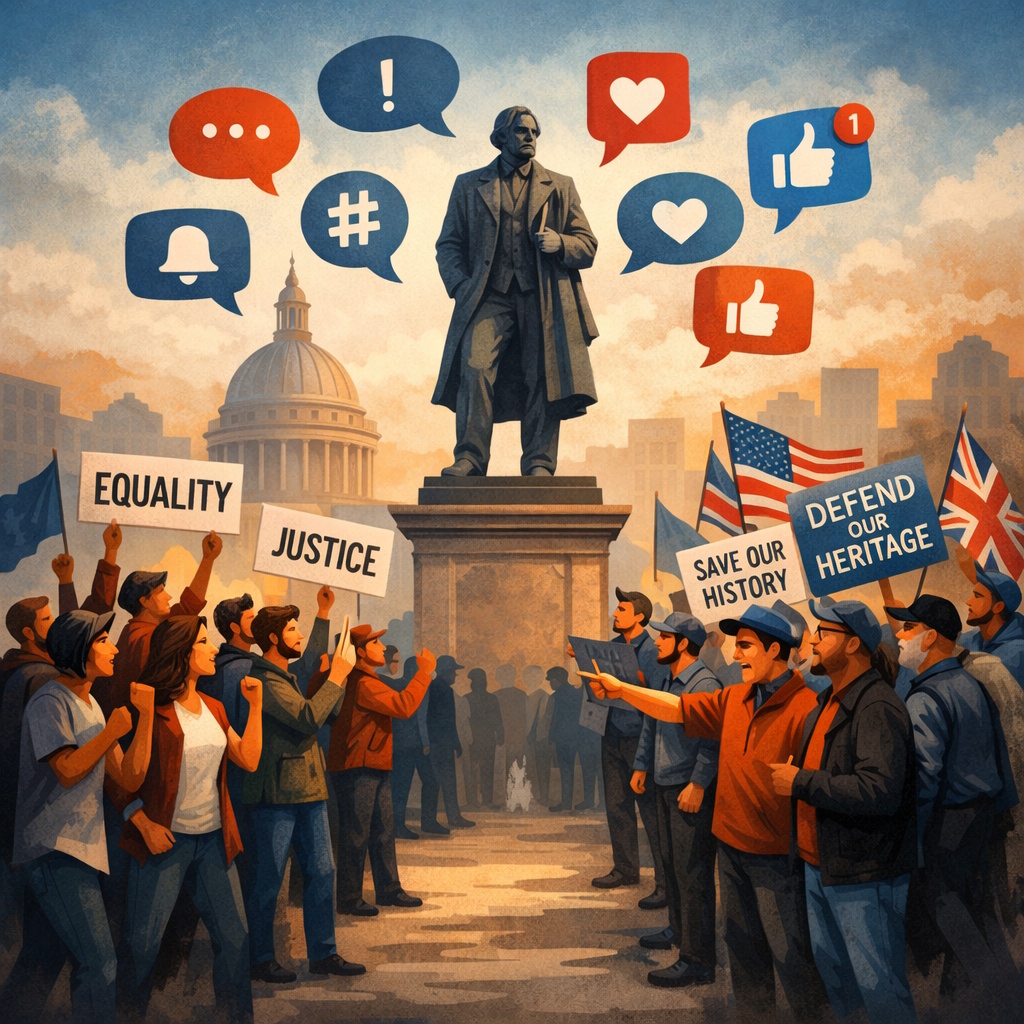
A video circulates on social media. In it, protesters pull down a statue of a colonial figure in a south-western British city. Some people cheer and share the clip with approving comments about justice and historical reckoning. Others are outraged. Politicians denounce the protest as criminal vandalism. Commentators talk about a “war on our history” and claim that the country’s core values are under threat. In response, counter‑protesters organise a march to “defend our heritage”.
Scenes like this have become familiar in recent years. They are often described as part of a wider “culture war”. Disputes about statues, flags, pronouns, school curricula, or public art are framed as battles over “British values”, “free speech” or “wokeness”. Each side claims to defend the true moral centre of society. The intensity of these arguments raises a classic Durkheimian question. What holds societies together when people disagree so deeply about what is right and wrong?
Émile Durkheim did not write about social media storms or culture‑war headlines. He wrote in the late nineteenth and early twentieth centuries, in a France marked by industrialisation, secularisation and bitter struggles over religion and the Republic. Yet he was preoccupied with questions that feel very close to contemporary concerns. How do societies create social order? How are shared norms and values formed and maintained? What happens when these norms break down, or when some groups feel excluded from the moral community?
This article introduces Durkheim’s core ideas about social facts, solidarity, law, crime and anomie. It then uses them to interpret contemporary culture‑war politics. The aim is to show what Durkheim still helps us understand about moral boundaries and social cohesion, where his framework is limited, and how later theorists have extended or challenged his ideas.
What Durkheim Said
Durkheim is often presented as the theorist of social order. He wanted to explain how societies remain coherent in the face of individual self‑interest and social change. His key concepts of social facts, solidarity and collective conscience are central to this project.
Context and Aims
Durkheim (1858–1917) wrote at a time of rapid transformation in France. Industrial capitalism was expanding. The power of the Catholic Church was declining. The Third Republic was seeking to create a secular national identity. Political crises such as the Dreyfus Affair exposed deep divisions around anti‑Semitism, nationalism and the authority of the army.
Durkheim saw sociology as a new science that could diagnose and address these tensions. He believed that social facts had to be studied as things, with their own properties and causal power (Durkheim, 1982). His work is less focused on class conflict or individual motives than on the patterns of social integration and moral regulation that make stable social life possible.
Social Facts
Durkheim’s starting point is the idea of social facts. He defines these as ways of acting, thinking and feeling that are external to the individual and that exert coercive power over them (Durkheim, 1982). Social facts exist outside particular persons. They include laws, institutions, shared beliefs, languages, currencies and moral codes.
For example, the rule that people must drive on a particular side of the road is a social fact. An individual driver did not create it and cannot change it alone. It shapes behaviour through law and through the expectations of other drivers. The fact that people drive on the left in the UK and on the right in many other countries shows that social facts can differ between places. They are not natural laws but collective decisions that become taken for granted.
Durkheim’s key move is to insist that these social facts have to be explained sociologically, not psychologised. We should not ask only why this or that individual is offended by a particular act. We should also ask what shared moral framework makes that act appear offensive in the first place.
Mechanical and Organic Solidarity
Durkheim is also concerned with solidarity – the bonds that tie individuals together into a moral community. In The Division of Labour in Society, he distinguishes between two ideal‑typical forms: mechanical and organic solidarity (Durkheim, 1984).
Mechanical solidarity is based on similarity. In societies with low division of labour, people share many beliefs, values and daily practices. The collective conscience – the common stock of ideas and moral feelings – is strong and relatively homogeneous. Deviance is more visible, and punishment is often harsh, because it threatens a deeply shared moral order.
Organic solidarity, by contrast, is based on interdependence. In modern societies, people carry out specialised roles. They do not all believe the same things or live in the same way. Solidarity arises from the fact that each depends on others to perform complementary tasks. The collective conscience is more diffuse. Law focuses more on restoring relationships than on dramatic displays of punishment.
Durkheim does not claim that any real society fits these ideal types perfectly. Rather, he uses them to think about different ways of organising social cohesion and about transitions from one pattern to another.
Law, Crime and Punishment
Durkheim treats law as a key indicator of solidarity. Repressive law, which focuses on punishing offenders, expresses a strong collective conscience. Restitutive law, which focuses on repairing damage and restoring normal relations, reflects more complex social arrangements (Durkheim, 1984).
He also insists that crime is normal in all societies (Durkheim, 1984). This does not mean that crime is harmless or desirable, but that no society can define itself without drawing boundaries between acceptable and unacceptable behaviour. Deviant acts provoke collective reactions. Public condemnation, trials and punishments reaffirm the values that have been violated. In this sense, the response to crime can strengthen social solidarity.
Punishment, for Durkheim, is not only instrumental. It does not simply deter future offending. It also has an expressive function. It is a ritual through which society communicates and renews its moral commitments.
Anomie
Durkheim later introduces the concept of anomie to describe situations of normlessness or deregulation. In The Division of Labour and Suicide, he uses the term to analyse crises where established norms break down or where people’s aspirations are no longer matched by the means available to them (Durkheim, 1951, 1984).
Anomie can arise in periods of rapid social change, economic upheaval or weakened collective regulation. Individuals may experience frustration, restlessness or despair when they lack clear guidance about what is expected and what is possible. Durkheim links anomie to certain forms of suicide, but the concept has since been used more broadly to talk about social disorientation.
Durkheim’s overall picture is ambivalent. He sees modern societies as moving towards organic solidarity, but he worries about the risk of anomie and the fragility of shared moral frameworks. These concerns resonate strongly with contemporary debates about polarisation and cultural conflict.
How We Can Interpret That Today
How can Durkheim’s ideas help us make sense of what journalists and politicians call “culture wars”? At first glance, these conflicts suggest a lack of solidarity. Yet from a Durkheimian perspective, they can also be read as struggles over the content of the collective conscience and over who counts as part of the moral community.
Social Facts in a Culture‑War Climate
Disputes about statues, flags, national holidays, school curricula or pronouns are disputes about social facts. They concern shared symbols and rules that organise collective life. When people argue about whether a statue should stand or fall, they are arguing about what that figure represents, whose history is being honoured, and what values the community should celebrate.
Durkheim’s concept of social facts encourages us to treat these arguments as more than individual preferences. They reveal tensions in the underlying moral order. For some, a colonial statue is part of national heritage. For others, it is a symbol of racial oppression. The same object sits within different moral worlds.
Similarly, debates about “British values” or about what should be taught in schools are not simply about information. They are about the norms and narratives that young people are expected to internalise. Durkheim would see the education system as a key site where the collective conscience is formed and transmitted.
Solidarity, Polarisation and Talk of Division
Commentators often claim that contemporary societies are “more divided than ever”. Durkheim gives us tools to ask what kind of solidarity is at stake. It may be that mechanical solidarity based on strong, homogeneous norms is weakening. At the same time, new forms of solidarity appear. People form tight bonds within movements, subcultures or online communities that share particular values.
From this angle, culture‑war clashes are not simply symptoms of collapse. They are also moments in which different groups seek to redefine the collective conscience. When activists campaign for trans rights, racial justice or decolonised curricula, they are putting forward rival visions of what solidarity should look like. When opponents denounce these campaigns as threats to “ordinary people” or “real” national values, they are doing the same from another position.
Durkheim helps us see that talk about “division” often rests on a desire to restore a previous moral consensus, whether or not that consensus was ever as stable or inclusive as imagined.
Crime, Deviance and Boundary Work
Durkheim’s idea that crime is normal and boundary‑producing is particularly relevant to culture‑war controversies. Many high‑profile incidents involve acts that are not always criminal in a legal sense but are treated as morally transgressive: a protest that disrupts a ceremony, a tweet that is labelled offensive, a piece of art that some find blasphemous.
Public reactions to such acts often follow a familiar pattern. Media outlets highlight them as examples of society going too far or not far enough. Politicians call for investigation, tougher laws or resignations. Online commentators demand boycotts or institutional discipline. In each case, denunciation and punishment communicate moral boundaries. They signal who is “one of us” and who has stepped outside acceptable limits.
From a Durkheimian perspective, these reactions are not only about controlling individuals. They are rituals through which the group reassures itself about its values. Whether the target is a protester, a teacher, a comedian or a civil servant, the conflict is framed as a test of what the community will tolerate.
Anomie and Narratives of Moral Decline
Culture‑war rhetoric often includes claims that society is experiencing moral decline. Older people may say that “you cannot say anything any more” or that young people have no respect. Others argue that racism, sexism or homophobia remain pervasive and that established norms are themselves unjust. In both cases, there is a sense that the moral order is unsettled.
Durkheim’s concept of anomie offers one way to think about this. Rapid social change, economic insecurity and political polarisation can weaken shared guidelines for behaviour. People may be unsure which norms apply, or they may feel pulled between conflicting expectations. This can produce anxiety and resentment that culture‑war narratives tap into.
At the same time, Durkheim’s language of anomie can be misused. Appeals to a lost moral order sometimes serve to defend older hierarchies of gender, sexuality, race or class. A critical Durkheimian approach needs to ask whose norms are being mourned and who was excluded or subordinated under those arrangements.
What Parts Are Still Relevant
Durkheim’s framework has clear limitations, but several aspects remain helpful for analysing contemporary moral and cultural conflicts.
Social Facts and Structure
First, the idea of social facts encourages sociologists to treat norms, symbols and institutions as real forces. Instead of explaining culture‑war disputes purely in terms of individual attitudes or personalities, we can examine the structures that shape what people take for granted.
Debates about what should count as offensive speech, who can claim certain identities or which histories are emphasised in school reflect struggles over social facts. Durkheim gives students a language for analysing these struggles without reducing them to personal sensitivities.
Solidarity and Collective Conscience
Second, Durkheim’s emphasis on solidarity and collective conscience remains valuable. It prompts questions such as: What kinds of solidarity are being promoted or threatened in this debate? Who is included in the “we” that politicians invoke? How do particular policies or campaigns seek to redefine who belongs?
These questions are particularly relevant when governments frame certain values as national essentials, or when movements claim to represent “the people” against an allegedly out‑of‑touch elite. Durkheim helps us see that these claims are about moral community as much as about policy.
Crime, Deviance and Normality
Third, Durkheim’s view of crime as normal and boundary‑drawing provides a useful lens on moral panics and “cancel culture” debates. Outrage over a protest tactic, controversial artwork or offensive remark can be understood as part of the ongoing work of drawing and redrawing moral boundaries.
This does not mean that all reactions are justified or harmless. But it reminds us that societies constantly negotiate the line between acceptable and unacceptable behaviour. What counts as shocking or deviant at one moment may be normalised at another. Durkheim encourages us to study these shifts historically rather than treat current norms as timeless.
Ritual and Collective Effervescence
Fourth, Durkheim’s later work on religion and ritual adds a helpful dimension. In The Elementary Forms of Religious Life, he argues that collective rituals generate collective effervescence – intense shared emotions that reinforce group identity (Durkheim, 1995).
Many culture‑war events have a ritual character. Demonstrations, counter‑protests, commemorations and online campaigns create shared rhythms and symbols. Participants often report feelings of exhilaration, anger or solidarity. Durkheim’s notion of collective effervescence helps us make sense of why people are drawn into these conflicts and why they can feel so emotionally charged.
What Parts Are Less Useful Today
Durkheim’s framework also has significant limitations when applied to contemporary societies marked by deep inequalities, postcolonial histories and dense media environments.
Assumptions of Consensus
Durkheim often assumes the existence of a relatively unified collective conscience. Even in modern societies with organic solidarity, he expects some basic moral agreement. This assumption can obscure the fact that different groups may hold radically different values, not only minor variations on a shared core.
In contemporary multicultural societies, there is no single moral centre from which deviance can be measured. Claims about a shared national culture often reflect the standpoint of dominant groups. Durkheim’s model needs to be reworked to account for persistent pluralism and conflict.
Eurocentrism and Colonial Blind Spots
Durkheim’s distinction between “simple” and “advanced” societies is rooted in a Eurocentric evolutionism. He often relies on colonial ethnographies of Indigenous peoples, treating them as exemplars of earlier stages of social development. This framework marginalises non‑European histories and reinforces a hierarchy in which Western societies appear more developed.
When contemporary culture wars involve questions of race, migration and empire, Durkheim’s blind spots become especially problematic. His theory does not offer tools for understanding how colonialism, racism and border regimes shape who is recognised as part of the moral community.
Underplaying Power, Race, Gender and Class
Durkheim tends to treat institutions as serving the needs of social integration as a whole. This functionalist orientation can underplay how norms and laws benefit some groups more than others. It can make inequality appear necessary or natural.
In culture‑war debates, appeals to social cohesion are often deployed to silence demands for racial, gender or sexual justice. Durkheim’s focus on order and solidarity does not by itself tell us how power operates through these appeals. To grasp that, we need to draw on Marxist, feminist and critical race perspectives that foreground conflict and domination.
A Narrow View of Law and Punishment
Finally, Durkheim’s account of punishment as an expression of collective outrage does not fully capture the strategic use of criminalisation and policing in contemporary societies. Research on institutional racism, class bias and the punitive turn in criminal justice systems shows that punishment often targets specific marginalised groups rather than expressing a unified moral conscience (Wacquant, 2009).
Durkheim’s approach alerts us to the symbolic dimensions of punishment but can obscure the ways in which law and order politics are mobilised to manage social crises and to defend threatened forms of power.
Other Theorists Who Have Extended Durkheim
A number of theorists develop Durkheimian themes while responding to these limitations. Their work is useful for making sense of culture wars, moral panics and struggles over belonging.
Cohen and Moral Panics
Stanley Cohen’s classic study of moral panics is often read as neo‑Durkheimian. In Folk Devils and Moral Panics, he analyses how media, politicians and the public responded to clashes between Mods and Rockers in 1960s Britain (Cohen, 2011). Cohen shows how certain groups are cast as “folk devils” who threaten the moral order. The intensity of the reaction is often out of proportion to the actual behaviour.
Cohen’s work extends Durkheim by highlighting how powerful actors help construct threats and by stressing the role of mass media in amplifying moral outrage. Moral panics are not spontaneous eruptions of collective conscience. They are shaped by political interests, news values and longer histories of stigma.
Hall et al. and Policing the Crisis
Stuart Hall and colleagues develop this line of analysis in Policing the Crisis (Hall et al., 1978). They study how the British media and state constructed a crisis around “mugging” in the 1970s. Drawing on both Durkheimian and Marxist insights, they argue that law‑and‑order campaigns helped manage wider economic and political tensions.
For Hall et al., moral panics about crime, race and youth are not only about social integration. They are also about the reassertion of authority and the protection of class and racial hierarchies. This perspective is especially relevant for contemporary culture wars in which questions of race, migration and policing are central.
Alexander and the Civil Sphere
Jeffrey Alexander’s theory of the civil sphere offers another way of reworking Durkheim. Alexander (2006) treats democratic societies as organised around a symbolic distinction between the civil and the anti‑civil. Inclusion in the civil sphere depends on being coded as rational, responsible and law‑abiding, while some groups are cast as irrational or dangerous.
Conflicts over free speech, protest and public symbols can thus be understood as struggles over who counts as a full member of the civil community. Alexander retains Durkheim’s interest in shared values but places more emphasis on contestation and on the role of social movements in expanding or restricting solidarity.
Wacquant, Punishment and Marginality
Loïc Wacquant’s work on punishment and marginality further complicates Durkheim’s account. In Punishing the Poor, he argues that welfare retrenchment and the expansion of penal institutions in the United States have combined to manage urban marginality (Wacquant, 2009). Punishment is less an expression of collective outrage than a tool for containing groups seen as problematic.
Wacquant builds on Durkheim’s concern with the social functions of punishment but insists on the centrality of class, race and neoliberal restructuring. His analysis is also deeply indebted to Bourdieu’s concepts of field, symbolic power and symbolic violence, which he uses to theorise the penal state and the stigmatisation of urban marginality. His approach invites similar questions about contemporary British debates on law and order, protest and welfare.
Bourdieu, Reay and Symbolic Power
Pierre Bourdieu adds a further layer by analysing symbolic power – the power to define what is legitimate, respectable or normal (Bourdieu, 1991). He shows how dominant groups impose their classifications as common sense. Those who internalise these classifications may misrecognise relations of domination as natural.
Diane Reay brings these concerns into the analysis of education and class. She explores how working‑class children and families experience schooling, and how middle‑class norms shape ideals of respectability and aspiration (Reay, 2005, 2017). Their work resonates with Durkheim’s interest in socialisation and moral order but foregrounds the psychic and affective dimensions of inequality.
Together, these theorists extend Durkheim into analyses of media, race, class and symbolic power. They provide tools for understanding culture wars as struggles over meaning and belonging that are deeply entangled with material inequalities.
Why Durkheim Still Matters for Culture Wars
Is Durkheim still relevant in an age of social media storms, culture‑war rhetoric and contested identities? Taken as a complete model of society, his work is limited. It assumes more consensus than many contemporary societies possess. It pays little attention to colonial histories, racialisation or gendered power relations. It can lean towards viewing institutions as functional for “society as a whole”, even when they harm particular groups.
As part of a critical toolkit, however, Durkheim remains valuable. His concepts of social facts, solidarity, collective conscience, crime and anomie encourage us to take moral conflicts seriously as social phenomena. They help us see that disputes about statues, curricula or pronouns are not trivial distractions from “real” politics. They are central to how communities define themselves and to how boundaries of belonging are drawn.
At the same time, Durkheim’s limitations remind us that any appeal to social cohesion must be examined critically. When politicians invoke “British values” or warn that certain movements threaten social order, we can ask Durkheimian questions – What norms are being defended? What forms of solidarity are imagined? – while also drawing on later theorists to interrogate whose interests are served.
For undergraduate students, Durkheim is therefore still worth reading. He does not tell us which side of any culture‑war dispute is right. Instead, he offers concepts for analysing how these disputes arise, why they feel so intense and how they relate to deeper structures of inequality and power. Used alongside Marx, Weber and their successors, Durkheim helps us think more clearly about what holds societies together, who is excluded from that “we”, and how struggles over values shape the social world.
References
- Alexander, J. C. (2006). The civil sphere. Oxford University Press.
- Bourdieu, P. (1991). Language and symbolic power (J. B. Thompson, Ed.; G. Raymond & M. Adamson, Trans.). Polity.
- Cohen, S. (2011). Folk devils and moral panics: The creation of the Mods and Rockers (3rd ed.). Routledge. (Original work published 1972)
- Durkheim, É. (1951). Suicide: A study in sociology (J. A. Spaulding & G. Simpson, Trans.). Free Press. (Original work published 1897)
- Durkheim, É. (1982). The rules of sociological method (S. Lukes, Ed.; W. D. Halls, Trans.). Macmillan. (Original work published 1895)
- Durkheim, É. (1984). The division of labour in society (W. D. Halls, Trans.). Macmillan. (Original work published 1893)
- Durkheim, É. (1995). The elementary forms of religious life (K. E. Fields, Trans.). Free Press. (Original work published 1912)
- Hall, S., Critcher, C., Jefferson, T., Clarke, J., & Roberts, B. (1978). Policing the crisis: Mugging, the state, and law and order. Macmillan.
- Reay, D. (2005). Beyond consciousness? The psychic landscape of social class. Sociology, 39(5), 911–928.
- Reay, D. (2017). Miseducation: Inequality, education and the working classes. Policy Press.
- Wacquant, L. (2009). Punishing the poor: The neoliberal government of social insecurity. Duke University Press.
Cite this article
Select a style and copy the citation into your document.